
Walking my way into Stillness
The Neuroscience of Slowing Down

Welcome to "The Slow Creative". It’s a space where to think about creativity beyond productivity. It's about slowing down, exploring ideas deeply, and understanding how creativity connects with life, work, and meaning. No hacks, no shortcuts—just thoughtful conversations and experiences. Creativity is about tuning, not being.
Life moves fast for me these days. Sometimes too fast.
Between project deadlines, writing a book, a tight calendar comprising meetings, personal and professional work, driving/picking up my 8-year old from school; being a parent, husband, and trying to appease my 3-year old girl’s wailings echoing throughout my house, tranquility sounds as an impossible feat.
In that scenario, walking has become a key practice for my own well-being. Walking isn't merely physical movement for me: it's a sacred act of slowing down, a necessary pause. It's the quiet connection to something deeper, something restorative. It puts my mind at ease. It resets my emotion kernel that tends to overwhelm frequently (as most of you HSPs - highly sensitive person - might know).
But then I wondered (BTW, Wonder will be part of a next post!)…
What does slowing down mean to science?
Science strongly supports that the act of "slowing down" is not merely the absence of movement or activity but a deliberate shift towards specific practices like meditation, journaling, mindful breathing, and mindful walking—each inducing measurable neurological changes associated with relaxation, creativity, emotional resilience, and cognitive clarity.
Let's explore how the brain interprets each of these practices, clearly detailing what occurs neurologically and suggesting practical steps to integrate them into daily life.
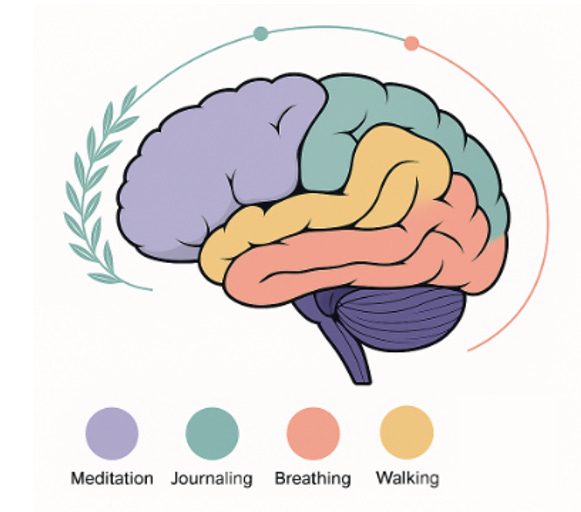
🧘 1. Slowing Down is Meditating
What is Meditation?
Meditation is the practice of intentionally focusing attention and eliminating the stream of thoughts that may crowd the mind. It often involves focusing on the breath, bodily sensations, or a mantra to cultivate presence, awareness, and inner calm.
When you meditate, your brain waves shift from high-frequency beta waves, typical of alertness and stress, to lower-frequency alpha and theta waves, promoting relaxation, creativity, and emotional stability. Meditation increases activity in the prefrontal cortex, which aids in emotional regulation, decision-making, and problem-solving. Concurrently, meditation heightens the activity in the insula, enhancing your bodily and emotional self-awareness, and reduces amygdala activation, lowering anxiety and stress responses.
What Happens in the Brain?
Prefrontal Cortex (PFC): Emotional regulation, decision-making, sustained attention.
Insula: Interoceptive and emotional self-awareness.
Amygdala: Decreased emotional reactivity and stress response.
Anterior Cingulate Cortex (ACC): Conflict monitoring and cognitive control.
Default Mode Network (DMN): Deactivation reduces rumination and self-referential thinking.
Practices Supported by Science:
Daily mindfulness meditation (10-20 minutes).
Breath-focused meditation sessions.
Loving-kindness meditation: To cultivate compassion and reduce self-criticism. This practice involves silently repeating phrases like “May I be happy, may I be healthy,” then gradually extending these wishes to others—loved ones, neutral people, and even those you find difficult. For a guided version, try the free meditations by Sharon Salzberg or Jack Kornfield. Here’s a link:
✍️ 2. Slowing Down is Journaling
What is Journaling?
Journaling, particularly expressive writing, is the act of putting thoughts, emotions, and experiences into words. It helps process emotions, clarify thinking, and make sense of inner experiences through narrative expression.
Expressive writing or journaling isn't merely introspective—it actively reshapes your brain. Journaling reduces activity in the amygdala, leading to decreased emotional stress, and enhances the functionality of your prefrontal cortex, improving clarity, emotional regulation, and narrative understanding.
What Happens in the Brain?
Prefrontal Cortex: Narrative processing, emotional regulation, meaning-making.
Amygdala: Reduced activation related to emotional distress.
Hippocampus: Emotional memory consolidation.
Broca’s Area / Language Networks: Activation during coherent storytelling
Practices Supported by Science:
Daily reflective journaling (10-15 minutes).
Expressive writing about emotional experiences.
Gratitude journaling to shift attention toward positive emotions.
🌬️ 3. Slowing Down is Mindful Breathing
What is Mindful Breathing?
Mindful breathing involves paying close attention to the natural rhythm of the breath without trying to change it. It’s a foundational mindfulness practice used to anchor attention, calm the nervous system, and bring awareness to the present moment.
Slow, intentional breathing significantly modulates brain activity, particularly in the medial prefrontal cortex, crucial for emotional regulation and executive functioning. Mindful breathing activates the parasympathetic nervous system via the brainstem and vagus nerve, reducing heart rate and cortisol, and inducing a state of calm. Best practises in the literature suggest slow-paced breathing exercises and a personal favourite, the Wim Hof Breathing Technique.
What Happens in the Brain?
Medial Prefrontal Cortex (mPFC): Emotional regulation and conscious control.
Brainstem (incl. nucleus tractus solitarius): Autonomic regulation of heart rate and respiration.
Insula: Interoceptive awareness of breath and bodily states.
Amygdala: Calms stress-related activation.
Vagus Nerve: Parasympathetic system activation (rest-and-digest response).
Practices Supported by Science:
Slow-paced breathing exercises (5-7 breaths per minute).
Box breathing (inhale-hold-exhale-hold): Used by athletes, military personnel, and therapists to quickly calm the nervous system and regain focus. Inhale slowly for 4 seconds, hold your breath for 4 seconds, exhale for 4 seconds, and then hold again for 4 seconds before repeating.
Wim Hof breathing technique, beneficial for reducing stress and boosting immunity. Here’s a guided breathing exercise by Wim Hof himself:
🚶 Slowing Down is Mindful Walking
What is Mindful Walking?
Mindful walking is the practice of walking slowly and intentionally while being fully aware of each step, your breath, and the sensations of your body moving. It’s often done in nature and serves as a moving meditation that cultivates presence and peace.
Mindful walking lowers activity in the Default Mode Network (DMN), a key brain network associated with mind-wandering and self-critical thoughts. It facilitates cognitive clarity, lowers cortisol, and enhances memory formation and emotional resilience by increasing hippocampal function.
What Happens in the Brain:
Hippocampus: Enhances memory and supports neurogenesis.
Default Mode Network (DMN): Reduced activation — less mind-wandering and self-talk.
Prefrontal Cortex: Boosts cognitive clarity and executive function.
Subgenual Anterior Cingulate Cortex: Decreased activity linked to lowered depression symptoms (especially during nature walks).
Practices Supported by Science:
Daily mindful walks (10-20 minutes).
Walking meditation, focusing on breath and footfall in silence.
Nature walks or forest bathing: Nature walks or forest bathing for at least 2–3 hours in a native forest have been shown to reduce cortisol, blood pressure, and activate the body’s rest-and-recovery systems. Sustained weekly practice supports emotional balance, immune function, and long-term well-being.
🎨 Slowing Down is Engaging in Flow-State Activities
Flow-state activities such as crafting, painting, or gardening deeply engage the prefrontal cortex and dopamine pathways, enhancing cognitive engagement and emotional satisfaction while reducing DMN activity, stress, and rumination.
[Figure: Simple brain outline highlighting Prefrontal Cortex (blue), Dopamine Pathways (blue), and Default Mode Network (red)]
Practices Supported by Science:
Regularly scheduled creative arts or crafting activities.
Enjoyable and focused tasks that induce a "flow" state.
🌟 Practical Neuroscience-Based Suggestions
To effectively integrate slowing down into your daily life, consider prioritizing single-tasking over multitasking, incorporating short restorative rituals such as tea breaks or naps, and regularly engaging in creative and reflective activities.
Recently, I engaged in a 12-week challenge with a group of colleagues, inspired by Julia Cameron’s book “The Artist’s Way”, writing what she calls Morning Pages. Despite I’ve been a supporter of journaling for a long time, and James Pennebaker’s work on the topic has been truly inspiring for me as a creative and a facilitator in emotional agility, just recently have I been sustaining a practice of journaling. Complementary to this, I’ve been reading and writing based on the daily prompts from
‘s “The Book of Alchemy”. Journaling has been truly therapeutic, and at the same time has allowed me to connect further to flow, insight and tuning to my own stream of consciousness.In a nutshell, I believe slowing down isn't simply pausing—it's actively enriches your life. By deliberately engaging with these scientifically-supported practices, I can assure you will nurture a healthier, more resilient, and creatively attuned brain.
And surely, this mindful slowing down resonates deeply with my journey into what I call SLOW Creativity, enhancing both personal growth and well-being and of course, towards a path based on integration and embracing my full Self.
Slow Down. Be better.
📚 References
Bratman, G. N., et al. (2015). Nature experience reduces rumination and subgenual prefrontal cortex activation. PNAS.
Csikszentmihalyi, M. (1990). Flow: The Psychology of Optimal Experience.
Gotink, R. A., et al. (2016). Mindfulness training and walking in nature. PLoS ONE.
Hölzel, B. K., et al. (2011). Mindfulness practice leads to increases in regional brain gray matter density. Psychiatry Research: Neuroimaging.
Khoury, B., et al. (2017). Breathing-based meditation and brain networks. Scientific Reports.
Lazar, S. W., et al. (2005). Meditation experience is associated with increased cortical thickness. NeuroReport.
Mather, M. (2020). Slow breathing increases heart rate variability and reduces anxiety. Wikipedia / LinkedIn.
Tang, Y.-Y., et al. (2015). The neuroscience of mindfulness meditation. Nature Reviews Neuroscience.
Pennebaker, J. (2004). Writing to Heal.
Salk Institute (2023). Neural circuits activated by slow breathing reduce anxiety. Salk Institute for Biological Studies.
Smyth, J. M., et al. (2018). Expressive writing and health: Self-regulation of emotion and cognition. Journal of Clinical Psychology.
Ulrich, R. S., et al. (2014). Flow states and well-being. Frontiers in Psychology.
Nice stuff. How do we defend against the pressure to speed up? It can seem so overwhelming to try to slow walking while in the middle of a culture that is designed like an 8-lane freeway with speeding traffic.
For me, slowing down is about rituals.
It usually starts with making a cup of coffee. Simple, but it sets the tone. Before I start working, I clean my desk. That physical reset helps clear my head too.
I also write things down by hand. I use a fountain pen and choose notebooks with good paper because it makes the process more enjoyable. Writing and sketching ideas this way slows me down just enough to think more clearly and stay present.
It’s not about being productive faster. It’s about starting with intention.